Home · The ripening-and-cultivar desk
Ripening and cultivars
How a banana ripens, and which banana it is
Colour, chemistry, trade and disease belong on the same desk, as long as each figure keeps its source.
Choose a topic. The table below stays put. It is the same set of published figures, seen together, not a different record.
Ripening conditions
The optimum conditions for ripening bananas, says CTAHR, are temperatures of 68 to 70 degrees F and 90% relative humidity. [CTAHR] During ripening, CTAHR says pulp temperatures should range from 58 to 64 degrees F. [CTAHR] Neither green nor ripe bananas should be stored at temperatures lower than 58 degrees F; the fruit will discolor and the flesh will become mealy at cooler temperatures. [CTAHR]
Those temperatures are from the University of Hawai‘i extension service. They are a practical range, not a single magic number.
Starch and sugar
As the fruit ripens, sugar content increases while starch content decreases. [CTAHR] Ethylene gas can be applied to bananas to start the ripening process and to assure evenness of ripening, and bananas also produce ethylene gas naturally. [CTAHR]
Green fruit is starchy. As it ripens, sugar rises. Ethylene, which bananas also make themselves, starts that change.
Cavendish
FAO says Cavendish bananas dominate international trade and are the most widely consumed banana variety globally. [FAO] In Hawai‘i, CTAHR lists Cavendish and Brazilians as the two major groups of dessert bananas, and the Cavendish group includes ‘Williams’, ‘Valery’, ‘Hamakua’, ‘Grand Nain’, and ‘Chinese’ varieties. [CTAHR] The same guidelines say TR4 infects most banana and plantain varieties including the Cavendish, which provides around 50 percent of global banana production. [FAO]
Cavendish is the export banana of our time. It is not the only banana, and it is not safe from every wilt.
Gros Michel
Gros Michel, FAO writes, used to dominate global exports until the 1950s, when widespread epidemics of Fusarium Race 1 (Foc R1) eliminated it from large-scale commercial production and the Cavendish subgroup became the new industry standard. [FAO] The Bluefields group, which includes ‘Bluefields’ and ‘Dwarf Bluefields’, was the leading commercial variety in Hawai‘i, and now accounts for less than 1% of banana production there because of its susceptibility to Panama wilt disease. [CTAHR] CTAHR lists the ‘Bluefields’ variety as ‘Gros Michel’. [CTAHR]
FAO tells the global story: Gros Michel dominated until Fusarium Race 1. CTAHR tells a Hawai‘i version of the same shift, under the name Bluefields.
Panama disease and TR4
FAO identifies the latest race causing banana Fusarium wilt in Cavendish cultivars, and many others, as Fusarium oxysporum f. sp. cubense tropical race 4 (Foc TR4), also known as Tropical race 4 (TR4). [FAO] FAO’s TR4 guidelines say the disease is caused by a fungus that lives in the soil, causes wilting and death of plants, and penetrates and blocks the vascular system, cutting off the supply of water and nutrients. [FAO] TR4 was first detected in Asia over 40 years ago, arrived in Africa in 2013, and reached Latin America in 2019, according to FAO. [FAO] The spores of the fungus, FAO notes, could survive in the soil for decades. [FAO]
Race 1 and Tropical Race 4 are related stories, not the same outbreak. The first unseated Gros Michel. The second is a problem for Cavendish.
A 100 gram portion
USDA FoodData Central lists “Bananas, raw” under FDC ID 173944, with the scientific name Musa acuminata Colla. [USDA FoodData Central] For a 100 g portion, the same record gives 89.0 kcal of energy and 74.91 g of water. [USDA FoodData Central] That 100 g portion has 22.84 g of carbohydrate by difference, 2.6 g of dietary fibre, and 5.38 g of starch. [USDA FoodData Central] Potassium is listed as 358.0 mg per 100 g, with 27.0 mg of magnesium and 8.7 mg of vitamin C. [USDA FoodData Central]
These are USDA figures for raw bananas, per 100 g. They are not a ripe-versus-green table.
A herb, not a tree
The banana plant is a large perennial herb with leaf sheaths that form trunk-like pseudostems. [CTAHR] Flower development is initiated from the true stem underground (the corm) 9 to 12 months after planting, and the inflorescence grows through the centre of the pseudostem. [CTAHR] Each bunch consists of a variable number of “hands” along a central stem, and each hand consists of two transverse rows of fruits, or “fingers”. [CTAHR]
The “trunk” is a pseudostem of leaf sheaths. The true stem is a corm in the ground.
Swipe to see the whole table.
| Topic | Published figure | How to read it |
|---|---|---|
| Optimum ripening (CTAHR) | 68–70 °F, 90% relative humidity | Extension advice for ripening rooms and kitchens, not a supermarket guarantee. |
| Pulp temperature while ripening (CTAHR) | 58–64 °F | A range during the ripening process. |
| Storage floor (CTAHR) | Not lower than 58 °F | Below that, the fruit discolors and the flesh becomes mealy. |
| What changes in the fruit (CTAHR) | Sugar rises, starch falls | The green-to-yellow change is chemistry, not only colour. |
| Cavendish in trade (FAO) | Dominates international trade; the most widely consumed variety globally | The banana in most export boxes today. |
| Gros Michel (FAO) | Dominated exports until the 1950s, then Fusarium Race 1 ended large-scale commercial production | CTAHR still lists Bluefields as Gros Michel, now under 1% of Hawai‘i production because of Panama wilt. |
| Cavendish and TR4 (FAO) | Around 50 percent of global banana production | TR4 infects Cavendish and most other banana and plantain varieties. |
| Nutrition, 100 g raw (USDA FDC 173944) | 89.0 kcal; 358.0 mg potassium; 22.84 g carbohydrate | One USDA record, for raw bananas, not a ripe-versus-green comparison. |
Checked on 15 November 2026. The desk does not average these sources, or treat a Hawai‘i extension note as if it were a USDA nutrient record.
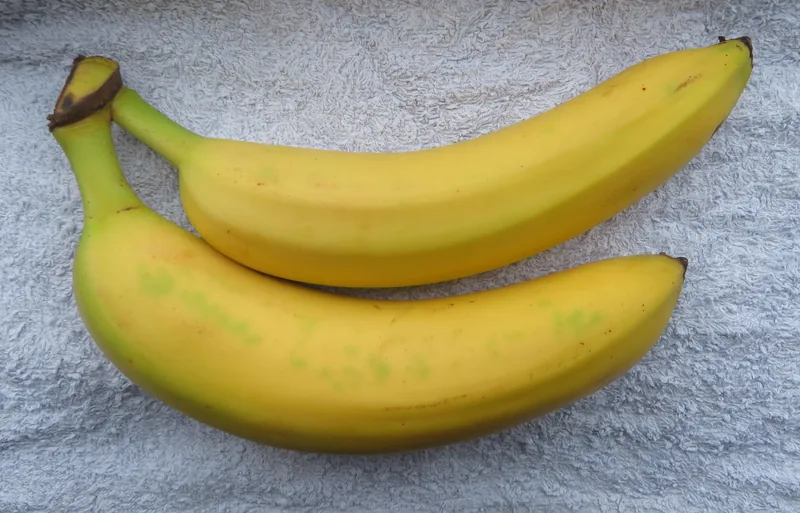
The photograph shows two Cavendish bananas in the middle of the colour change, not a complete stage chart.